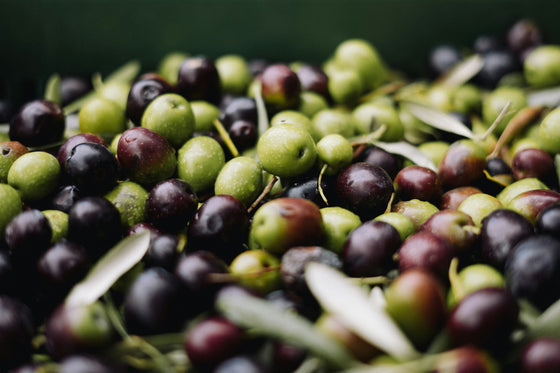
Early harvesting can help produce olive oil with a distinctive green flavour and substantial phenolic content. It is an important production decision, not a guarantee that the earliest-picked oil will always have the highest number or the best balance.
What ripening changes
As olives mature, the composition of the fruit and the oil it produces changes. A study of the Corbella cultivar found that total phenols decreased with advancing maturity, while some individual phenolic groups behaved differently. The result supports the importance of timing, but not a rule that every compound in every cultivar peaks on the same date.
Variety and season complicate the picture
Research comparing cultivars, locations and crop years found that phenolic content was affected by cultivar, maturity and environmental conditions. The relationship between rainfall, temperature and phenolics was not identical across all circumstances. Early is therefore relative to the fruit and the season, not simply a calendar label.
The mill still matters
Crushing and malaxation, the mixing of olive paste before separation, also influence the phenolic profile. In the Corbella study, different processing conditions favoured different outcomes. This makes it misleading to attribute a finished oil's entire result to picking date alone.
The wider review by Jimenez-Lopez and colleagues places harvest timing alongside genotype, agricultural conditions, extraction and storage.
How to assess an early-harvest oil
- Look for an identified cultivar and harvest.
- Use a batch-specific analysis for numerical claims.
- Read tasting notes as flavour information, not a laboratory result.
- Ask how production choices supported the intended style.
GRO's FORTE philosophy explores the combined contribution of variety, site and timing rather than treating extreme earliness as the sole objective. That is a production approach, not proof that any one factor caused a particular phenolic result.
Read our guide to terroir and phenolics and the difference between cold pressing and cold extraction.